Background: Why Foundational Numeracy Matters
Across India, foundational numeracy remains one of the most pressing challenges in education. Studies, including ASER reports and national assessment surveys, have repeatedly shown that a large proportion of children in Grades 1–5 struggle with even the most basic mathematical tasks:
- Recognizing numbers
- Counting and sequencing
- Understanding place value
- Performing simple addition and subtraction
Without these building blocks, children face serious hurdles when transitioning to higher grades, where mathematics becomes more abstract and complex. Beyond academics, numeracy also equips children with problem-solving, confidence, and logical reasoning skills — all critical for lifelong learning.
Press enter or click to view image in full size

Prof. Jyothi Basu Yerramadha, IMSE, put it succinctly:
“Foundational numeracy is not just about numbers — it’s about confidence, problem-solving, and setting a child up for lifelong learning.”
This is where targeted early interventions make all the difference—ensuring that children are not left behind in the crucial first years of their schooling.
Aveti Learning’s Approach: ARAMBH
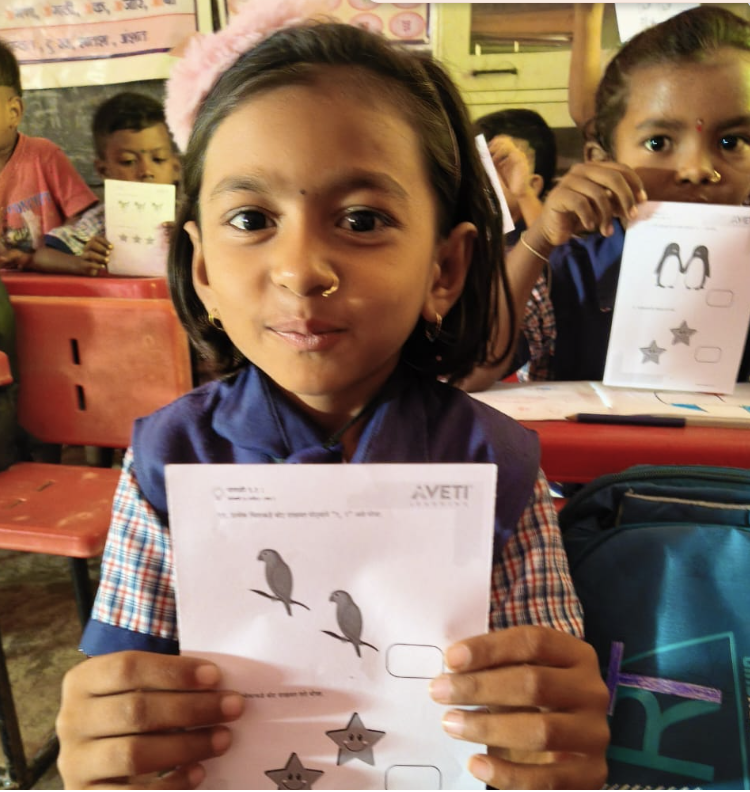
At Aveti Learning, we address this challenge through ARAMBH—the Foundational Numeracy Program, a structured intervention designed specifically for children in Grades 1 to 5. The program uses a guided, worksheet-based approach that helps children progressively build essential mathematical competencies — from number recognition and counting to place value, operations, and problem-solving.
What makes ARAMBH distinct is its strong emphasis on mother-tongue learning: the worksheets are developed in the child’s own language, enabling greater clarity, confidence, and engagement. To extend its reach and impact, Aveti is actively integrating digital delivery with localized content, ensuring that even children in remote or under-resourced contexts have access to joyful, effective numeracy learning.
Sushant Mahapatra, Aveti Learning, explains the vision:
“At Aveti, we believe young educators bring fresh energy and creativity to solving long-standing educational challenges. Gayatri, Susmita and Yasodha’s contributions to ARAMBH were impactful — they helped us strengthen our resources and reaffirm our vision of making quality, mother-tongue-based learning accessible to every child.”
Press enter or click to view image in full size

University Collaborations: Nurturing Changemakers
In July–August 2025, Aveti Learning hosted three students — Gayatri Varsha Vitthal Jumnake and Susmita Patra from the Indira Mahindra School of Education (IMSE), Hyderabad, and Yasodha Mehta from Azim Premji University, Bangalore — for their summer internship.
The students joined as Content Interns, with a primary responsibility to:
- Translate ARAMBH worksheets (Preschool to Grade 5) into Hindi,Marathi and Bengali
- Pilot the materials in schools and community centers and Engage with teachers and parents to collect feedback and refine the learning experience
Yasodha reflected on her experience:
“Working with Aveti allowed me to see how curriculum design translates into classroom practice. Observing how children responded to the worksheets in real time was an eye-opener — it reinforced my belief that learning materials must be simple, contextual, and joyful if they are to truly make an impact.”
Piloting in West Bengal & Maharashtra
During the pilot sessions, the students observed how children interacted with the worksheets:
- Did they follow the instructions easily?
- Were they engaged and motivated to solve problems?
- Where did they struggle, and what kind of support from teachers was most effective?
The interns also engaged parents in personal meetings, demonstrating how they could use Aveti’s digital worksheets at home. This parent-focused engagement was critical, as home learning reinforces classroom concepts and builds continuity in a child’s education.
Press enter or click to view image in full size

Susmita Patra shared her reflections:
“This internship taught me the importance of creating simple, effective learning materials in the child’s own language. Observing children in classrooms and interacting with parents gave me a new perspective on how learning actually happens. It has deepened my commitment to work in early childhood education.”
The pilot in West Bengal and Maharashtra generated rich feedback:
- Teachers found the worksheets to be structured and adaptable for mixed-level classrooms.
- Children showed higher engagement when examples were localized (familiar contexts, mother tongue).
- Parents appreciated having simple, guided tools to support their child’s learning at home.
These insights helped refine the worksheets further — small changes in language, design, and instruction clarity made them more effective, joyful, and child-centered.
For Gayatri, the experience was both professional and personal:
“Working with Aveti Learning was an enriching experience. Translating worksheets into Marathi helped me see how small efforts can make a big difference in children’s learning. I realized that education is most powerful when it is inclusive, local, and joyful.”
Press enter or click to view image in full size

A Shared Vision for the Future
The collaboration stands as a powerful example of how academia and grassroots innovation can come together to create lasting change in education. By engaging young educators in real-world, field-based projects, we not only enrich their professional journeys but also design tangible, community-driven solutions for India’s children.
Prof. Srinivas Rao S, Dean, IMSE, reflected on the partnership:
“Experiential learning is at the heart of IMSE. We want our students to step into real classrooms and community spaces, and understand how education translates into lived experiences for children. Aveti Learning provided that platform, and we are grateful for this meaningful partnership.”
Looking ahead, Aveti Learning is committed to enabling rural learners and facilitators to build strong foundations in literacy and numeracy. Through programs like ARAMBH, we aim to empower teachers and community facilitators with the right tools, curriculum-aligned methods, and localized resources to guide every child at the right learning level.
Technology will play a central role in this journey — helping us ensure scalability, consistency, and accuracy across diverse and under-resourced contexts. From low-cost multi-tablet models that support adaptive learning to personalized digital resources accessible offline, our approach combines innovation with inclusivity.
The promise of this collaboration lies not just in improved test scores, but in confident learners, capable facilitators, and thriving rural classrooms. With committed partners like IMSE, motivated interns like Gayatri, Susmita, and Yasodha, and Aveti’s vision for joyful, mother-tongue-based learning, we are confident that the seeds planted today will grow into a future where every child counts — not just numbers, but opportunities, dreams, and possibilities.
Press enter or click to view image in full size
